Major commemoration
You can celebrate other milestones like sending your children to school, when they complete formal education or even when you retire from paid employment. I can write that special ceremony to suit any occasion.
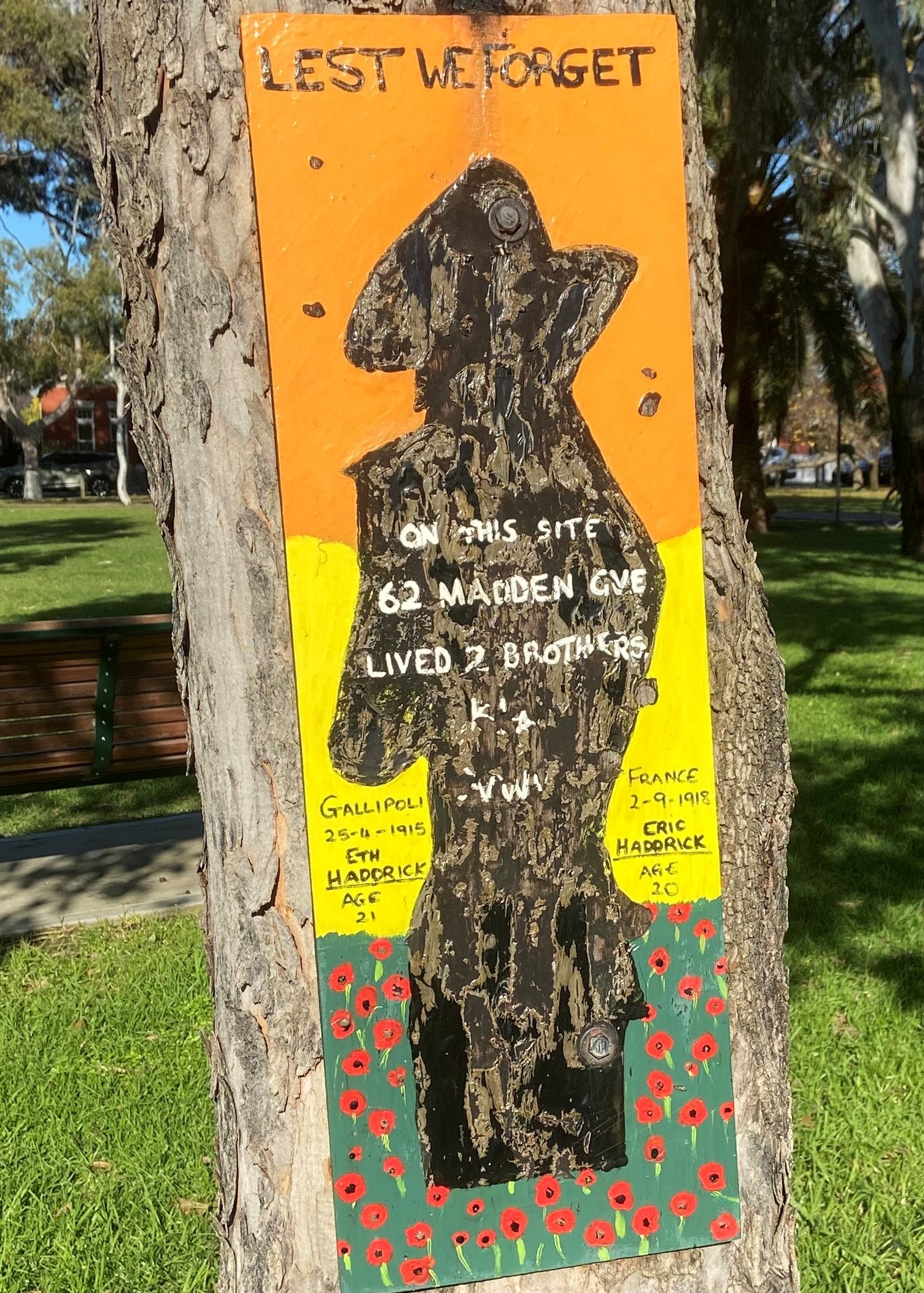
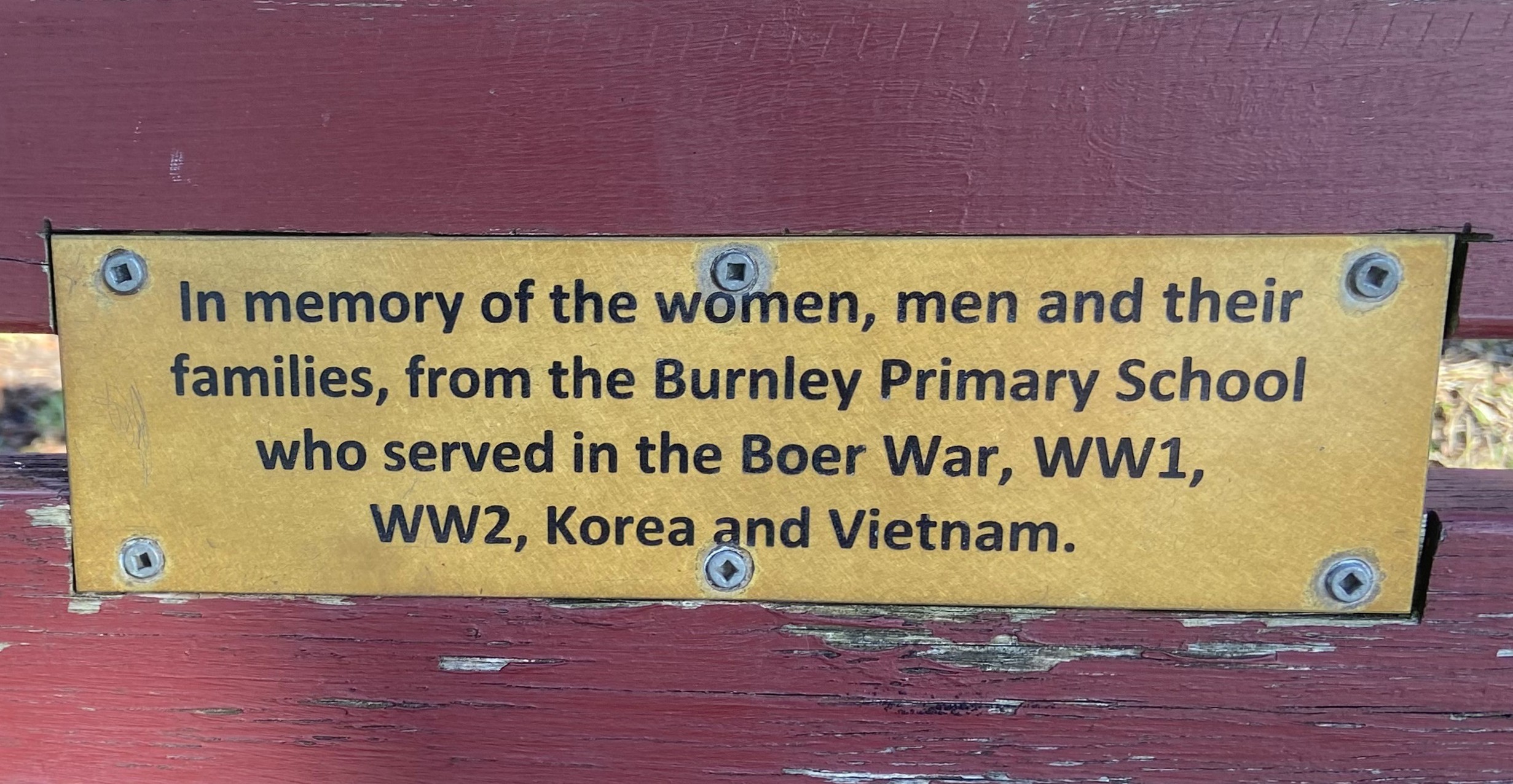
I was contacted by neighbors who asked me to conduct an Armistice Day ceremony in the Golden Square Bicentennial gardens to commemorate the passing of 100 years since the signing. A park bench was going to be unveiled as it had a plaque commemorating the milestone.
Armistice Day 2018
Welcome to the Golden Square Bicentennial Gardens in Burnley. Today’s ceremony is to commemorate the signing of the Armistice in a railway carriage outside Compiegne, France 100 years ago which was signaling the end of hostilities in the 1914 – 1918 war. The war officially ended with the signing of the Treaty of Versailles which dictated the peace terms in 1919.
Simply put the war was partially a family feud between two cousins, the vain German, Kaiser Wilhelm II and George V, the British King.
For many years Germany wished to be the predominant world power and commenced an armament program including the building of battleships following the Bismarck plan. Germany had long wanted to usurp the British position as the prime European land and naval power. As German generals were sabre rattling, and as fate would have it, Grand Duke Franz Ferdinand heir to the Austro-Hungarian throne and his wife were assassinated in Sarajevo and Germany invaded Belgium after several threats.
With the invasion of Belgium, Britain, France and Russia declared war on Germany which saw the escalation of conflict. Turkey became a German ally while Japan sided with Britain, Russia and France. In time France was invaded when the German forces crossed the Maginot line and marched into Paris. Britain was worried and appealed to its colonies in Australia, New Zealand, Canada and India for assistance in raising an army, essentially to protect Britain and Europe.
After the British Navy’s dismal failure to invade Turkey by attempting to sail to Istanbul in an attempt to keep the sea lanes open in order to guarantee supplies to the forces, Churchill in his wisdom decided that Turkey could be invaded near the Dardanelles. To this end many of the Australians and New Zealanders were shipped to Egypt to prepare them for the invasion of Turkey.
On April 25, 2015, the ANZAC forces attempted a shore landing at Gallipoli at a place now known as ANZAC cove. Anyone looking at the foreboding hills from the sea would know that such an invasion would be difficult, and many young lives were wasted in this attempt. Australians and New Zealanders fought valiantly but the Turks under the leadership of Atta Turk held firm even though the allies captured some ground. Eventually the allies retreated under the cover of darkness.
I was on a ship in the exclusion zone on April 25, 2015, near Anzac Cove and attended the ship’s Dawn Service, then watched the service from Gallipoli via the ABC. Following the service, we sailed close to the cove, and I was immediately overcome with the incredulity of attempting a landing at such a place.
This was the first massive balls up at the instigation of the British politicians and Generals who would continue to fumble in the many of the theatres of war. Fighting was occurring in Europe and the Middle East as the Allies tried to stop the German advance.
Another bloodbath occurred on the Somme in France and on the fields of Flanders where the Germans had built a series of communication and other trenches and had been there for some time. The British under General Douglas Haig and General John French ordered the allied troops to dig in on the Somme. Unlike the Germans the British trenches were hastily dug and only gave basic cover and proved to be terrible accommodation for the soldiers.
Battle lines were drawn and the opposing forces faced each other in their trenches which were defended by barbed wire. In the middle was no man’s land and as there was a stalemate, the British, in their wisdom often gave the order for the boys to go over the top and charge the enemy. This was like sending lambs to the slaughter as the Germans peppered the troops with machine gun fire and there were many casualties. The conditions on the Somme and huge loss of life prompted Wilfred Owen the First World War poet to write ‘Futility’
Move him into the sun—
Gently its touch awoke him once,
At home, whispering of fields half-sown.
Always it woke him, even in France,
Until this morning and this snow.
If anything might rouse him now
The kind old sun will know.
Think how it wakes the seeds—
Woke once the clays of a cold star.
Are limbs, so dear-achieved, are sides
Full-nerved, still warm, too hard to stir?
Was it for this the clay grew tall?
—O what made fatuous sunbeams toil
To break earth’s sleep at all?
The carnage was just as great in Belgium and many soldiers were victims of the German experiment with chemical warfare as they used mustard and Chlorine Gas. One of the victims was my uncle as he had breathing problems until his death in the 60’s.
In the east, Germany was more successful, and the disorganized Russian army suffered terrible losses, spurring the outbreak of the Russian Revolution in 1917. By the end of 1917, the Bolsheviks had seized power in Russia and immediately set about negotiating peace with Germany.
A lot of fighting on the Somme was centered around the village of Villiers Bretonneux, which was initially taken by the British, then lost. Much fighting occurred around the railway line and in the neighboring forest and many Canadian, New Zealand, British and Australian lives were lost. The Australians under the command of General John Monash captured the village on April 25, 1918, and held it against heavy odds. This capture halted the German advance which was headed for Amiens and would cut off all allied forces. This helped turn the tide of the war.
The Somme is basically flat and is subject to rain and snow for much of the year and was freezing in April 2018 when we attended the Dawn Service on Anzac Day. Even though it wasn’t snowing the heavy rain made it difficult for us to stay in the open even with our modern cold weather clothing. I can imagine it was far worse for our boys then, carrying their rifles and heavy packs and being subjected to heavy enemy fire.
Another factor which helped the allies was the sinking of the Lusitania which was making its passage from America to Britain by German U boats. As many American lives were lost America joined the war and as the Americans were fresh, they quickly overpowered the Germans and relieved the other soldiers.
Given these factors the Germans surrendered and a peace treaty was drawn up and this document was signed in the railway carriage on November 11, 2018, at 11:00 am 100 years ago. It was meant to be the war to end all wars, because of the great slaughter and destruction it caused.
Unfortunately, the peace treaty that officially ended the conflict—the Treaty of Versailles of 1919— forced punitive terms on Germany that destabilized Europe and laid the groundwork for World War II, but as we know it was only the beginning.
We are gathered here today to remember the sacrifice of our soldiers in many theatres of war and to commemorate this milestone. As a tribute to our fallen we have placed 100 poppies round this park to mark each of the years since signing this document. Poppies grew on the fields of Flanders after the carnage and the poppy is a symbol of remembrance.
Mark will now read the poem ‘In Flanders Fields’ by John McCrae.
In Flanders fields the poppies blow
Between the crosses, row on row,
That mark our place, and in the sky,
The larks, still bravely singing, fly,
Scarce heard amid the guns below.
We are the dead; short days ago
We lived, felt dawn, saw sunset glow,
Loved and were loved, and now we lie
In Flanders fields.
Take up our quarrel with the foe!
To you from failing hands we throw
The torch; be yours to hold it high!
If ye break faith with us who die
We shall not sleep, though poppies grow
In Flanders fields.
Oh, valiant hearts who to your glory came through dust of conflict and battle flame, tranquil you lie your knightly virtue proved, your memory hallowed in the land you love.
The hour has come for rest, these poppies, an emblem of sacrifice, the symbol of a life given in the service of one’s country is a link between our comrades and us who remain, we place them in remembrance.
I ask you to join me, reverently, in a silent tribute to the fallen.
(The Last Post is played)
They shall not grow old as we that are left grow old
Age shall not weary them, nor the years condemn
At the going down of the sun and in the morning
We will remember them
Congregation: We will remember them
Lest we forget
Congregation: Lest we forget
(The Reveille is played)
I do have other stories to tell